

Why Tractor Paintwork Needs to Be Tougher Than Automobile Paint – A Deep‑Dive into Tractor Body Panel Coating Technology
Sep 14, 2026
Operating‑Environment Characteristics & Anti‑Corrosion
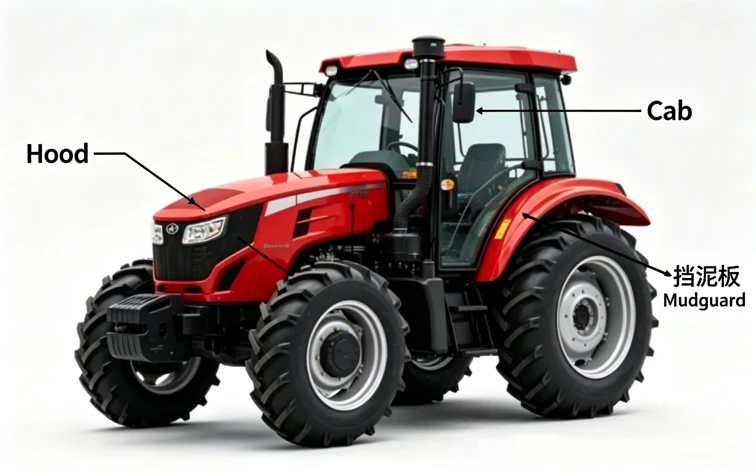
Unlike passenger cars, tractors operate almost constantly in open‑air conditions. Steel thin‑gauge components such as engine hoods, fenders, fuel tanks (on certain models), and tractor cabs endure long‑term thermal ageing caused by direct solar radiation. They also suffer erosive wear from mud, crop straw and sand particles, plus chemical attack from corrosive agents including fertilizers, pesticides and de‑icing salts. Most tractors are stored outdoors. Water, oxygen and electrolyte salts create ideal conditions for electrochemical metal corrosion. Humid field conditions combined with corrosive contaminants greatly accelerate rusting on steel tractor body panels.
The core function of paint coatings is forming a continuous physical barrier between steel substrates and corrosive media. If local paint damage is left unrepaired, corrosion spreads horizontally underneath the paint film, leading to hidden under‑film corrosion. By the time rust blisters appear on the surface, large‑area metal deterioration has usually already occurred.
It should be highlighted that tractors face harsher service conditions than passenger vehicles. Therefore, tractor paint must meet or even exceed automotive‑grade standards for anti‑corrosion and weather‑resistance. Cutting corners on coating processes brings higher long‑term costs, such as component replacement, sheet‑metal repairs and sharp drops in resale value of the whole tractor.
Key Technical Specifications for Tractor Body‑Panel Coatings
Tractor cabs and exterior panels serve long‑term in harsh environments featuring high humidity, intense sunlight, wind and dust. Performance assessments follow the Chinese industry standard JB/T 5673‑2015 General Technical Requirements for Painting of Agricultural and Forestry Tractors and Machines. Four core evaluation dimensions are paint‑film thickness, surface appearance, mechanical strength, and environmental / ageing resistance.
Paint‑film thickness Primer minimum thickness ≥ 15 μm; topcoat minimum thickness ≥ 40 μm; total coating thickness ≥ 55 μm. Sufficient and uniform dry‑film thickness forms the fundamental barrier against water, oxygen and corrosive contaminants.
Surface appearance Smooth, even surface with consistent colour. No sagging, bare substrate exposure, blistering, pinholes or pitting. Gloss level ≥ 90 %.
Mechanical performance Impact resistance ≥ 4.9 N·m; flexibility Grade 1 or higher; pencil hardness ≥ 2H; adhesion Grade I‑II. These properties defend against sand erosion, operational vibration and minor knocks during assembly and field work.
Environmental and anti‑ageing performance Water resistance ≥ 120 h; salt‑water resistance ≥ 80 h; salt‑spray test: 1000 h with no blistering or rust formation. After 800 hours of xenon‑lamp accelerated weathering test, colour fading and gloss loss achieve Grade I, ensuring long‑term coating stability under humid, salt‑laden and strong‑UV conditions.
These indicators build a complete evaluation framework: qualified film thickness → acceptable appearance → robust mechanical strength → durable long‑term performance. They serve as factory‑acceptance criteria as well as process targets for coating production lines.
Multi‑Layer Coating Structure & Typical Painting Workflow
Tractor panel coatings are multi‑layer composite systems built outward from the metal substrate: primer, intermediate coat and topcoat. Each layer fulfils defined complementary functions. The primer bonds to steel and delivers primary anti‑corrosion protection. The intermediate coat (together with putty filling) smooths surface irregularities, improves inter‑layer adhesion and boosts stone‑chip resistance. The topcoat delivers final colour, gloss and outdoor weather resistance.
On real‑world production lines, these coats are applied sequentially through connected process stages: pre‑treatment, cathodic electrodeposition & post‑rinsing, putty filling & sanding, and topcoat spraying.
Pre‑treatment Stage
Workpieces go through manual pre‑cleaning then are hung on conveyor racks. Sequential steps include pre‑degreasing and full degreasing to remove stamping oil and anti‑rust grease. Multiple tap‑water washing cycles are followed by surface conditioning and phosphating to generate a dense uniform conversion film on steel surfaces. Further multi‑stage washing and deionised‑water rinsing remove residual chemicals and ionic contaminants before draining.
Cathodic Electrodeposition & Post‑Rinsing Stage
Pre‑treated parts are fully immersed in temperature‑controlled electrodeposition tanks for cathodic e‑coating primer deposition. After exiting the tank, workpieces go through ultrafiltration (UF) spray rinsing and multi‑step UF 1 / UF 2 washing plus deionised‑water rinsing. This recovers residual paint and eliminates floating paint and secondary sagging. After draining, parts enter hot‑air recirculation ovens for high‑temperature curing of e‑coat films, then are force‑cooled down to ambient temperature.
Putty Filling Stage
After e‑coat curing and cooling, workpieces move to the putty station. Putty is applied to cover stamping depressions and weld seams. After putty baking and forced cooling, layers are sanded carefully and dust is wiped away to create a flat base for subsequent topcoats.
Topcoat Spraying Stage
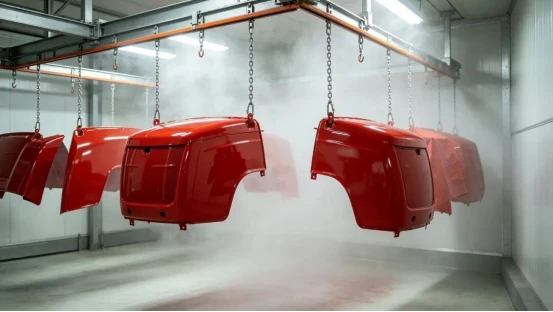
Surfaces are cleaned thoroughly prior to spraying. Certain components such as fuel tanks receive separate primer application, flash‑off and primer curing cycles. The facility then applies topcoats via "wet‑on‑wet" spraying technology. Workpieces go through flash‑off for paint levelling and bubble release before entering hot‑air ovens for topcoat curing. Finished parts are force‑cooled, inspected offline. Qualified products move to unloading; defective items go for rework.
Actual process routes vary for tractor cabs, large panels, small‑to‑medium covers and fuel tanks due to differences in structure, material and operating location. Fuel tanks need extra primer cycles, while certain draining and UF rinsing stations are designed mainly for large‑size body panels and not required for all components.
In general terms: coating quality depends 30 % on paint material performance and 70 % on pre‑treatment plus in‑process control. Even with identical paint formulas, variations in bath‑solution parameters, washing cleanliness, curing temperature standards and spray‑booth environment control lead to huge gaps in long‑term anti‑corrosion durability for tractor paintwork.
Main Causes of Premature Tractor‑Panel Coating Failure
Insufficient surface pre‑treatment Incomplete removal of rust and mill scale traps corrosive residues underneath paint layers. These embedded contaminants gradually trigger paint blistering and peeling over time.
Over‑reliance on thick putty layers Heavy multi‑layer putty hides poor flatness of stamped metal sheets. Excessively thick putty absorbs paint, tends to crack and absorbs moisture. The result is smooth‑looking surfaces with poor inter‑layer bonding underneath.
Poor cleanliness inside spray workshops Sanding, putty application and spraying performed in shared work zones. Airborne dust lands on wet paint films and creates surface granules, pinholes and pitting. These defects form entry points for moisture and corrosive substances.
Inadequate film thickness and incomplete curing Single‑pass spraying results in insufficient dry‑film build. Low‑temperature paint formulations with inadequate curing show few visible flaws under normal conditions. However, high‑humidity high‑salt conditions such as long‑distance export maritime transport bring widespread paint blistering and under‑film rust.
Future Development Trends for Tractor Panel Coating Technology
Three major upgrading directions are shaping modern tractor painting processes:
Water‑borne paint adoption Driven by stricter environmental‑protection regulations, low‑VOC water‑based topcoats are gradually replacing traditional solvent‑borne paints, improving working conditions inside paint shops.
Non‑metallic lightweight substrates To cut vehicle weight and fundamentally eliminate steel‑part rust and shipping‑related paint damage, composite materials such as fibreglass‑reinforced plastic are used for components including tractor fenders. Material innovation removes the root conditions for electrochemical corrosion.
Automotive‑grade coating standards Driven by agricultural‑machinery exports and high‑end product upgrades, stricter controls are implemented for coating thickness, adhesion, salt‑spray resistance and accelerated weathering performance.
Conclusion
Tractor‑body‑panel painting is heavily process‑driven. Visible colour gloss is only the final outcome. Service life of tractor paint is determined chiefly by pre‑treatment quality, cathodic electrodeposition primer performance and strict on‑site process management. Pre‑treatment sets the lower limit for coating durability, while disciplined process control defines its upper limit.
During product selection and daily maintenance, pay close attention to coating integrity on critical zones including weld seams and folded edges. Timely repair any paint damage to maximise service life of tractor exterior panels.


